
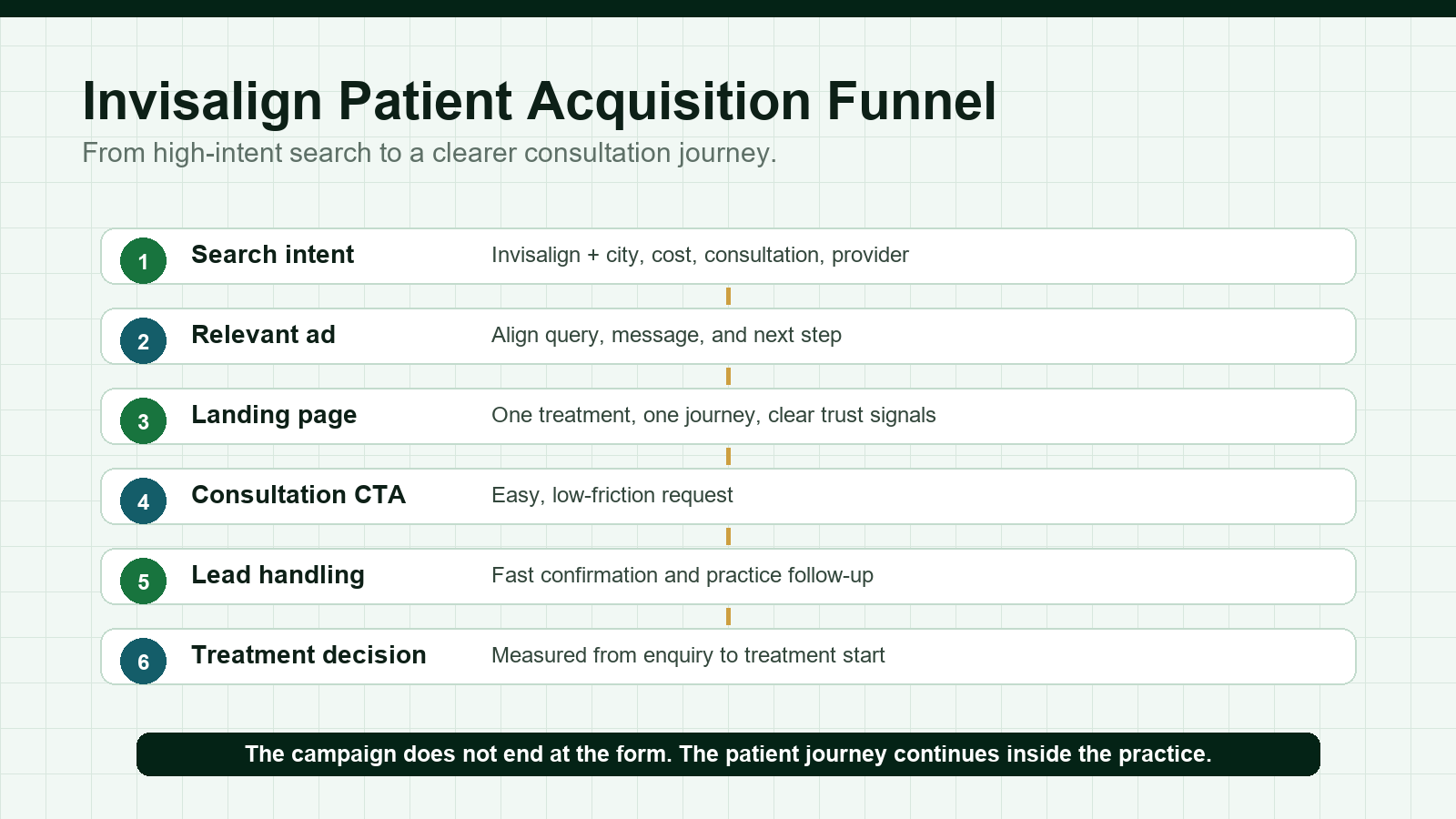
When someone searches for Invisalign or clear aligners, they are often further along than someone searching for general dental information. They may already be comparing providers, researching costs, checking treatment options, or deciding whether to book a consultation.
1. Start With Treatment-Specific Search Intent
A common mistake is sending every paid search visitor to the practice homepage. A patient searching for "Invisalign dentist Chicago" has a different intent from someone searching for "dentist near me." The landing experience should reflect that difference.
A treatment-focused campaign can be structured around intent groups such as Invisalign plus location, Invisalign consultation plus location, clear aligners plus location, Invisalign cost plus location, Invisalign provider plus location, and brand-related searches where appropriate.
Keyword isolation is not about excluding everything informational. Someone searching for Invisalign pain or Invisalign cost may still become a patient. The better approach is to examine search-term data and separate high-intent, research, and clearly irrelevant searches.
Google Ads supports keyword match types and negative keywords, but negative keyword decisions should be based on actual relevance rather than a fixed list copied from another practice.
2. Build a Landing Page Around One Treatment
Once someone clicks an Invisalign advertisement, avoid sending them straight into the practice's entire website. Give them a page that answers the questions they are most likely asking.
The first screen should make four things clear: what treatment is being discussed, who provides it, why the patient should consider the practice, and what they can do next.
Considering Invisalign in [City]? Start With a Consultation.
Request an Invisalign Consultation.
Explore whether clear aligner treatment is appropriate for your smile, with treatment planned by [Doctor/Practice Name].
Patient reviews, doctor credentials, relevant treatment experience, location, consultation explanation, and genuine financing details.
Avoid claims such as "best," "top-rated," or "guaranteed results" unless the practice can substantiate them. Healthcare advertising should be truthful, supported, and reviewed for the market being targeted.
3. Trust Should Come Before the Form
An Invisalign prospect is not simply deciding whether to submit a form. They are deciding whether they feel comfortable putting their treatment in the hands of this practice.
The page should answer questions behind the click: Who is the dentist? How experienced is the practice? What does the treatment process look like? What should the patient expect during the first consultation?
- Consultation
- Assessment
- Treatment planning
- Aligner treatment
- Follow-up
Real treatment examples can help prospective patients understand the type of cases a practice treats, but before-and-after cases should be used carefully. Use genuine patient cases, appropriate permission, clinical context, and any required professional or advertising disclosures.
4. Make the Consultation Easy to Understand
The CTA should not feel like a commitment to purchase treatment. It should feel like the next logical step.
Instead of pushing a hard-sell message, the experience can say: "Tell us a little about what you would like to improve and we will help you understand whether clear aligner treatment may be suitable."
The form can remain simple: name, phone or email, preferred appointment time, and what the patient would like to discuss. Avoid collecting unnecessary sensitive information through marketing forms.
5. Make Pricing More Transparent
Cost is often part of the patient's decision process. That does not necessarily mean publishing a single universal treatment price.
Practices can explain what determines Invisalign treatment cost, whether consultation fees apply, whether financing is available, what payment options exist, what is included in treatment, and whether insurance may contribute.
If the practice advertises a specific price or monthly payment, that figure should be genuine and accompanied by any material conditions that affect the offer.
6. The Lead Response System Matters
A campaign does not end when someone submits a form. There is a second system behind the landing page: search, ad, landing page, consultation request, immediate confirmation, practice follow-up, booked consultation, consultation, and treatment decision.
The marketing team can measure the first half. The practice controls much of the second half. A campaign can generate enquiries without generating appointments if the practice is slow to respond or if enquiry handling is inconsistent.
7. Track the Funnel, Not Just the Click
CPC is useful, but it does not tell the whole story. A more useful measurement framework connects search impressions to clicks, landing-page visits, leads or calls, booked consultations, attended consultations, treatment acceptance, and treatment starts.
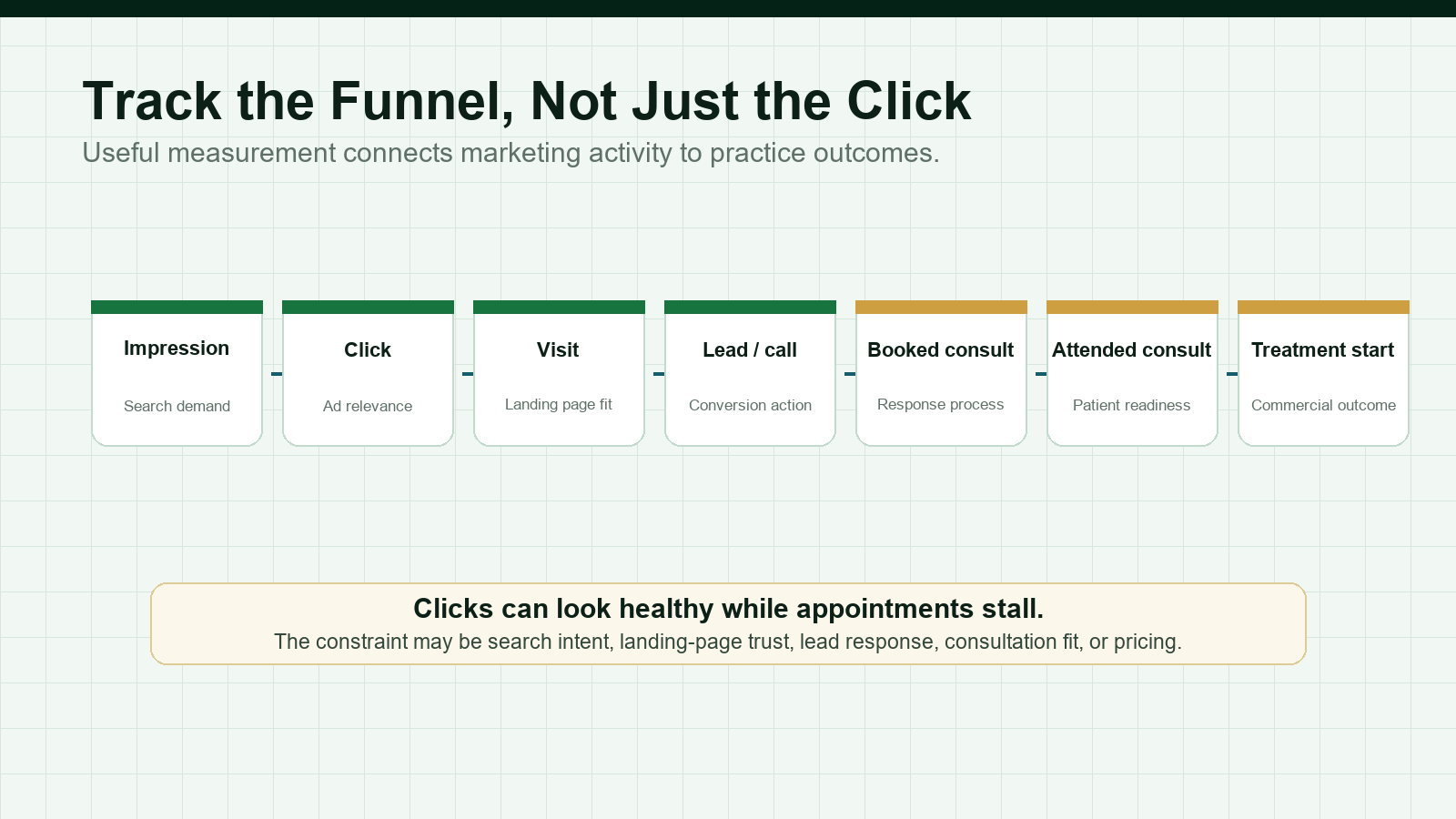
If there are lots of clicks but few enquiries, review search intent, ad relevance, and the landing page. If there are lots of enquiries but few appointments, review lead quality, response time, and the front-desk process. If there are consultations but few treatment starts, review consultation experience, treatment fit, pricing, financing, and case presentation.
8. A $12,000 Ad Budget: The Right Way to Model It
Rather than claiming that a $12,000 monthly budget will produce a specific amount of revenue, model different scenarios. Conservative, base-case, and strong-performance models can show how CPC, landing-page conversion, booking rate, treatment acceptance, and average treatment value affect commercial viability.
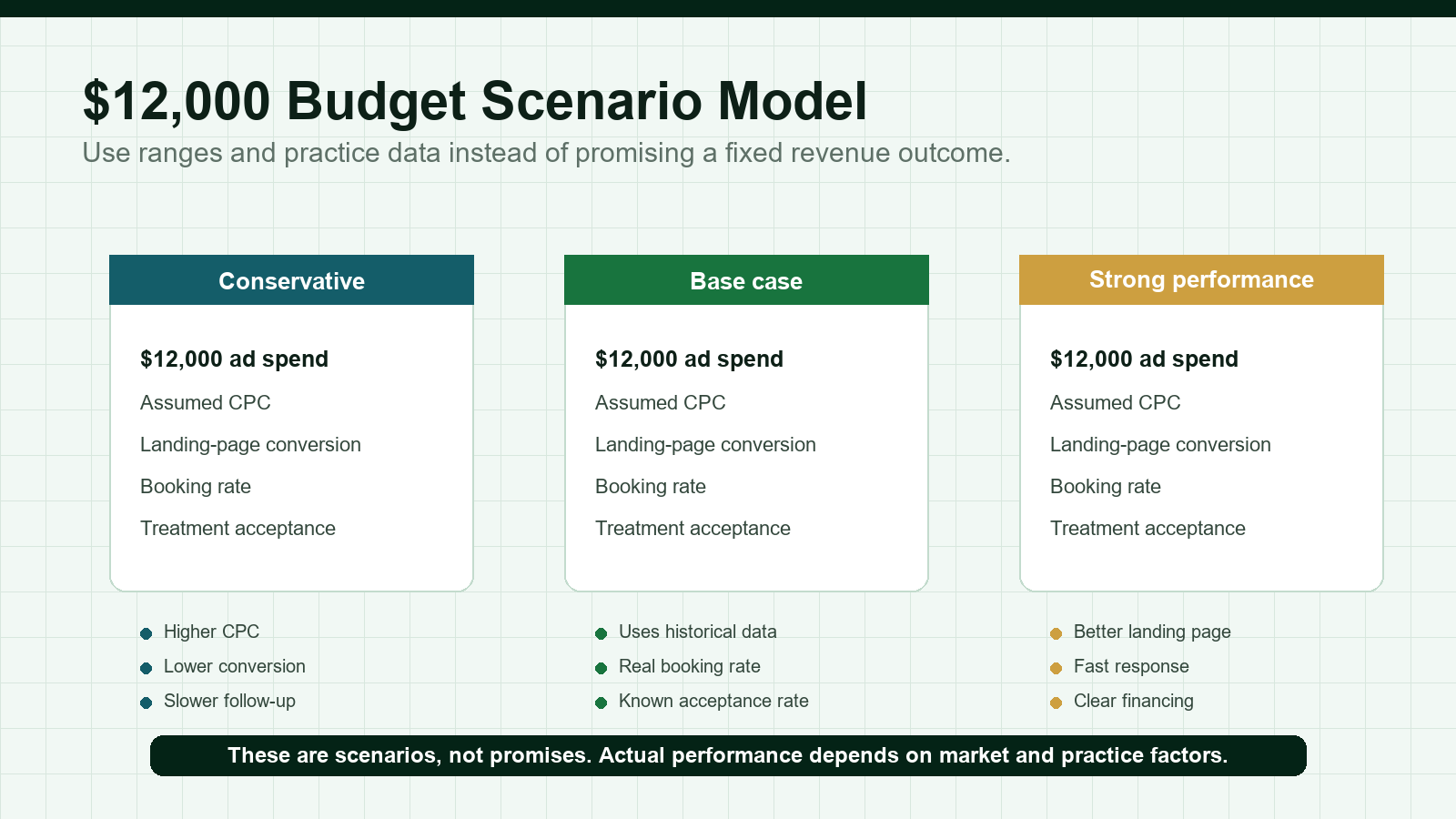
Actual performance depends on location, competition, search demand, auction dynamics, practice reputation, offer, landing-page experience, lead response, consultation quality, treatment pricing, case acceptance, and patient eligibility.
9. The Numbers That Actually Matter
For an Invisalign acquisition campaign, Earth Craft Digital would want to understand cost per qualified enquiry, cost per booked consultation, cost per attended consultation, cost per treatment start, average treatment value, treatment acceptance rate, revenue generated from paid acquisition, and return on advertising spend.
The practice should distinguish between a lead, a qualified patient, a booked consultation, and a treatment start. Those are not the same thing.
The Real Funnel
A strong Invisalign campaign is not simply Google Ads to form to patient. It is search intent, relevant advertisement, treatment-specific landing page, trust and clinical information, clear consultation CTA, fast lead handling, booked consultation, clinical consultation, treatment decision, measurement, and improvement.
Each stage has a different job. If one stage is weak, increasing the advertising budget will not necessarily solve the problem.
Build the System Around the Practice, Not a Template
There is not one universal Invisalign funnel that works for every dental practice. A Chicago cosmetic dentist with 500+ reviews, an orthodontic practice in New York, and a growing suburban dental practice may require completely different positioning, offers, landing pages, and campaign structures.
Earth Craft Digital starts with the practice. We look at search visibility, patient intent, website experience, treatment pages, local presence, trust signals, conversion paths, lead handling, and measurement. Then we identify where the patient journey could be clearer.
Want us to look at yours? Request a Website Observation for a focused review of how a prospective Invisalign or clear aligner patient might experience your practice online.
Frequently Asked Questions
Should Invisalign ads send traffic to the practice homepage?
Usually, a treatment-specific landing page is clearer because Invisalign searchers are often comparing providers, costs, consultations, and treatment suitability.
What should an Invisalign landing page include?
It should explain the treatment, introduce the clinician or practice, show appropriate trust signals, describe the consultation, clarify pricing factors, and make the consultation request easy to complete.
Can a dental practice guarantee Invisalign campaign results?
No. Results depend on market, campaign, practice, and patient factors. Budget models should be presented as scenarios, not promises.
Which funnel metrics matter most?
Cost per qualified enquiry, cost per booked consultation, cost per attended consultation, cost per treatment start, treatment acceptance rate, average treatment value, revenue from paid acquisition, and return on ad spend.