
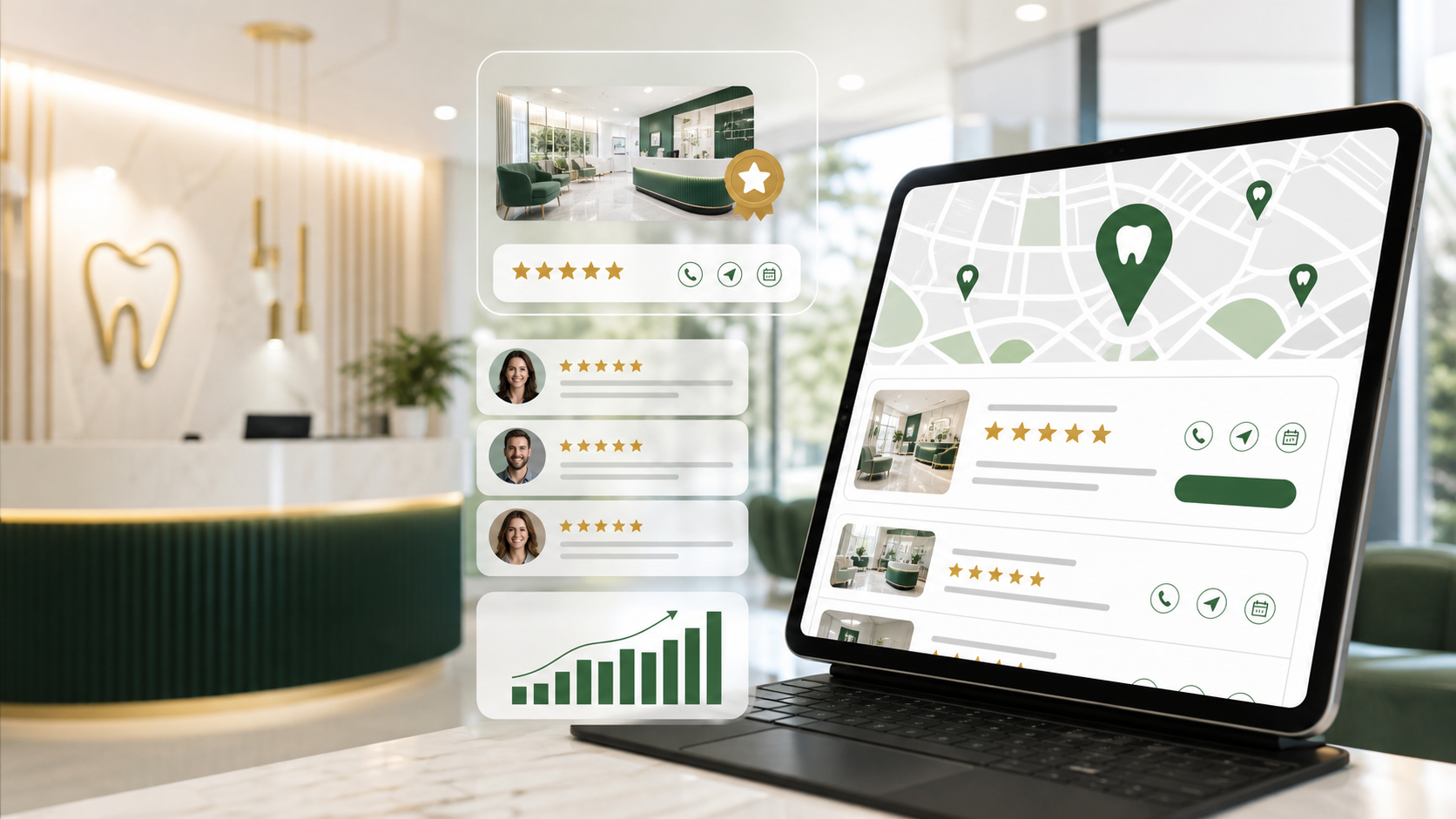
Local visibility is not simply about ranking. It is about being understood, discovered, evaluated, and chosen.
You may have an established location, experienced dentists, satisfied patients, and years of local presence. Yet when someone searches "dentist near me" or "dentist in your city," another practice may appear first.
The reason is that Google local search considers more than proximity. A practice's Business Profile, website, reviews, and other online signals all contribute to how Google and patients understand the practice.
Understanding Local Search
When a patient searches for a dentist, Google is trying to answer a practical question: which businesses are the best matches for this person and this search?
Google identifies three major factors in local ranking: relevance, distance, and prominence.
How well the practice matches what someone is searching for, such as emergency dentistry, cosmetic dentistry, implants, or family care.
The physical relationship between the searcher and the practice. This helps, but it does not guarantee visibility.
How well-known and credible the practice appears to be, supported by links, reviews, ratings, and online information.
A practice does not need to trick Google into ranking it. It needs to give Google and prospective patients clearer evidence about what the practice is, where it is, and why it is relevant.
Why Visibility Matters
It is tempting to think that appearing somewhere in Google is enough. It is not. Patients have choices, and many review only a small set of local businesses before making a decision.
BrightLocal research shows that consumers consider factors such as proximity, ratings, review count, and listing completeness when evaluating local businesses. For dental practices, that creates two separate challenges: getting discovered and being considered.
The Local Visibility Chain
A useful way to diagnose a dental practice's online presence is to look at the patient journey as a chain:
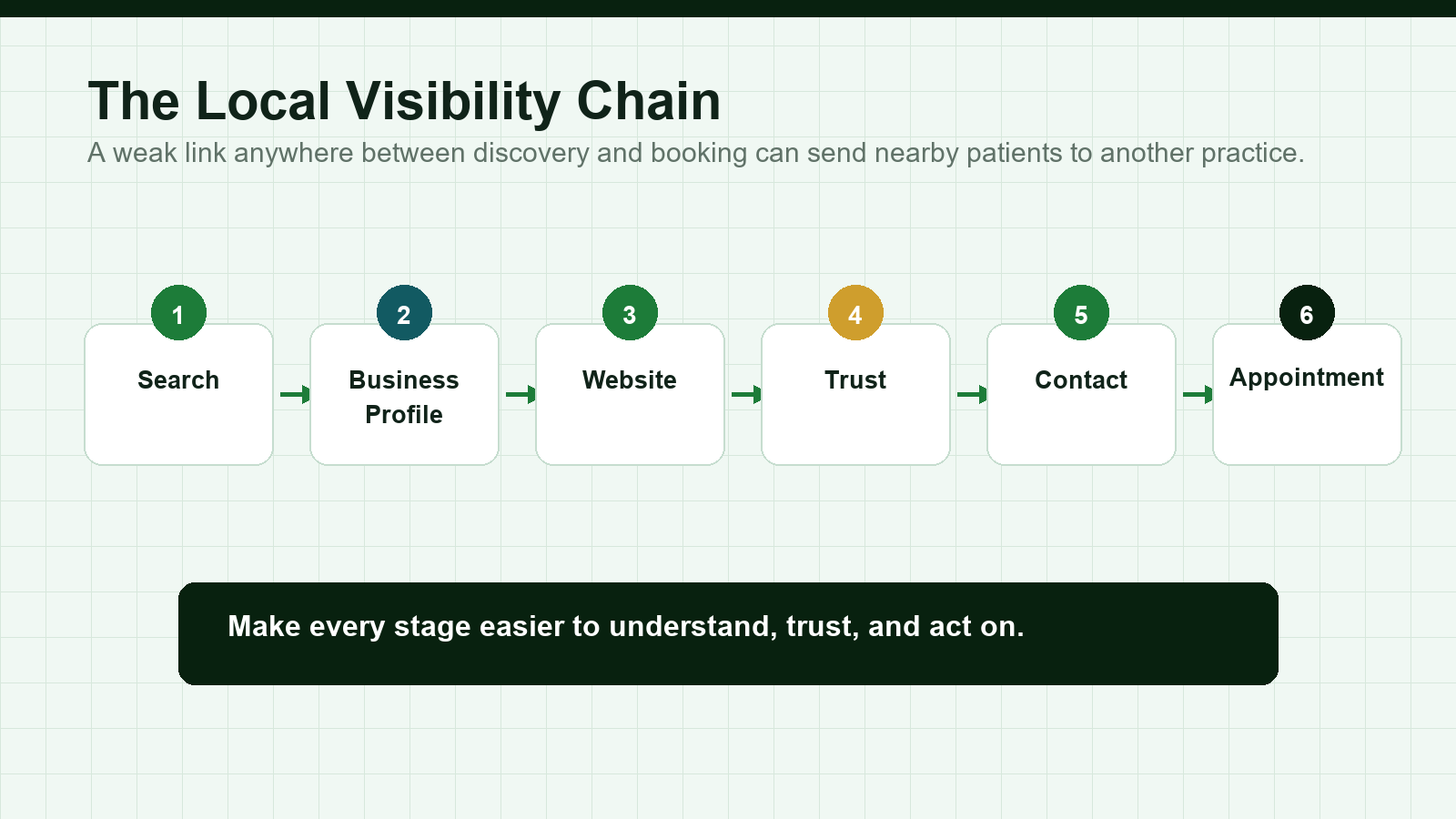
If the practice does not appear for relevant local searches, patients may never know it exists. If the Business Profile is incomplete, the listing may not clearly communicate the practice. If the website is confusing, patients may not understand the services or location. If trust signals are weak, they may choose another clinic.
Google Business Profile Issues
For many dental practices, the Business Profile is one of the first places to investigate. Google says businesses with complete and accurate information are more likely to appear in relevant local searches.
1. Is the primary business information accurate?
Check the practice name, address, phone number, website, hours, and business category. Even small inconsistencies can create confusion for patients and search engines.
2. Does the profile accurately represent the services?
Think about the real reasons patients contact the practice: general dentistry, emergency dentistry, dental implants, cosmetic dentistry, Invisalign, pediatric dentistry, or sedation dentistry. The goal is not keyword stuffing. The goal is clarity.
3. Are the photos useful?
Exterior images can make the location easier to recognize. Interior images can reduce uncertainty. Team and dentist photographs can make the practice feel more familiar before the first visit.
4. Are reviews being treated as reputation evidence?
Reviews should not be viewed simply as a number. Patients read the details. Authentic patient experiences can communicate what the visit felt like, how staff treated patients, whether communication was clear, and what patients appreciated.
5. Is the information consistent?
Compare the Google Business Profile with the website. Does the address match? Does the phone number match? Are hours and services represented consistently? Consistency makes the practice easier to understand.

Website Optimization Gaps
A strong Business Profile can get someone to your website. But what happens next?
A patient does not visit a dental website to admire its SEO. They visit because they have questions: Do you provide the treatment I need? Where are you located? Can I trust this practice? How do I contact you? Can I request an appointment?
Make the location obvious
Do not make patients hunt for the address. The practice location should be easy to find from important pages, especially the homepage and contact page. If you serve a specific community, communicate that naturally.
Make services understandable
Each major service should answer basic patient questions. For example, an implant page can explain what dental implants are, who may be a candidate, what the process involves, common questions, and the next step.
Do not forget mobile patients
A patient may search from a phone while commuting, at work, or after realizing they need an appointment. Review text size, navigation, page loading, click-to-call functionality, appointment buttons, contact information, forms, pop-ups, and service-page readability.
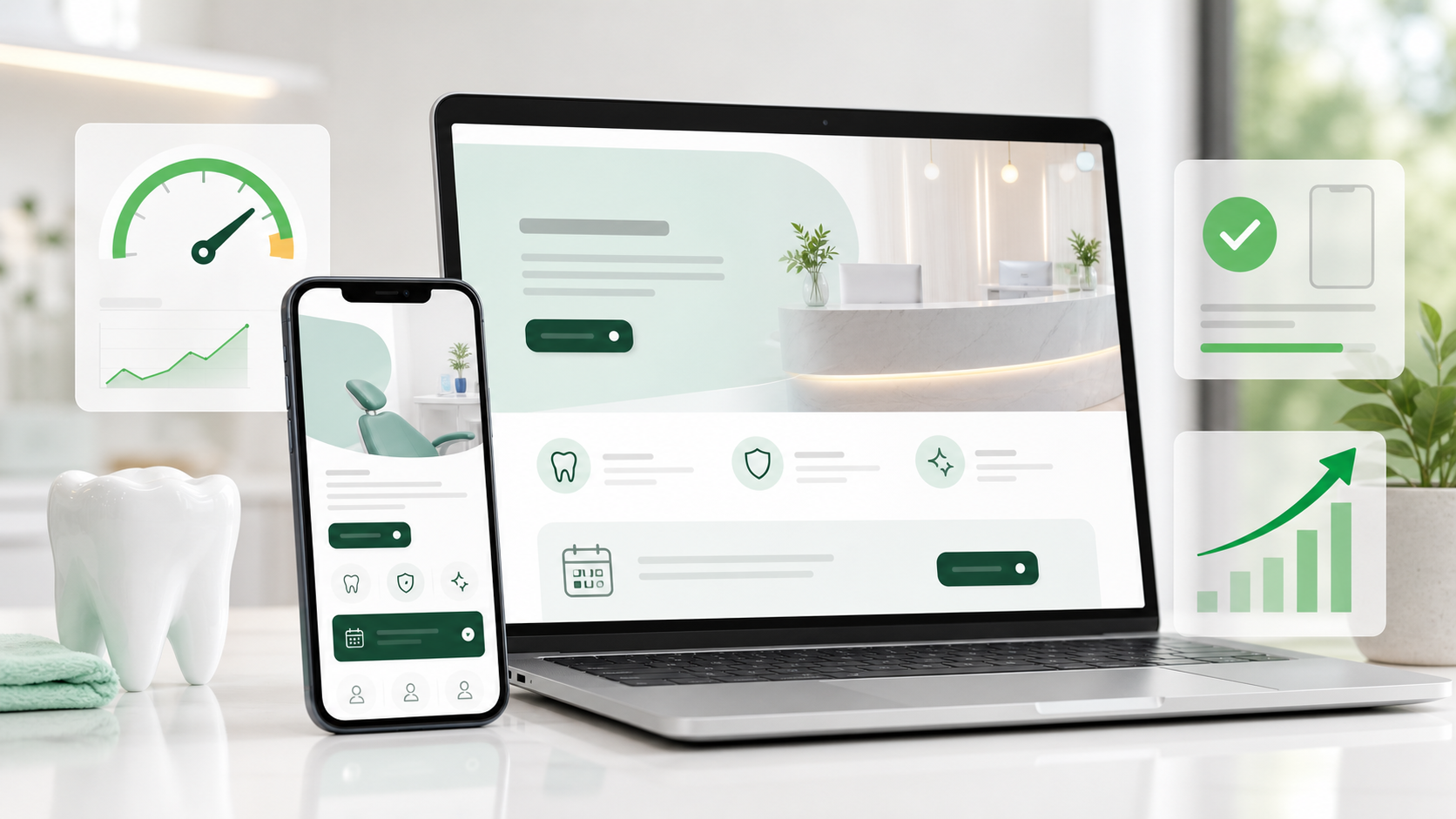
Build trust before asking for the appointment
A dental website has an unusual challenge. Patients are not simply buying a product. They are choosing someone to provide healthcare.
Useful trust elements can include dentist biographies, professional qualifications, real practice photography, treatment explanations, patient reviews, clear contact information, transparent practice details, frequently asked questions, and appropriate before-and-after examples where relevant and ethically presented.
Practical Ways to Improve Your Local Visibility
Step 1: Test your own visibility
Search from the areas you actually want to serve. Try searches such as "dentist near me," "dentist city," "service dentist city," "emergency dentist city," and "neighborhood dentist." Look for patterns rather than treating one search as a definitive ranking report.
Step 2: Audit the Business Profile
Check accuracy, completeness, category, services, hours, photos, website link, contact details, reviews, and recent updates.
Step 3: Review the website as a patient
Forget SEO for ten minutes. Pretend you are a new patient. Can you understand the practice within 30 seconds? Can you quickly determine where it is, what it does, who the dentists are, what services are offered, and how to request an appointment?
Step 4: Study competitors, not just rankings
Choose three practices that consistently appear for important searches. Compare what patients are being given elsewhere that your practice may not be providing.
| Area | Your Practice | Competitor |
|---|---|---|
| Business Profile completeness | ||
| Primary services | ||
| Photos | ||
| Reviews | ||
| Website clarity | ||
| Appointment path |
Step 5: Strengthen the entire visibility chain
Think beyond rankings. Can the right patients discover the practice? Does the listing clearly explain who you are? Does the website answer the patient's questions? Does the online reputation support the decision? Is it easy to call or request an appointment?
What Not to Do
- Do not buy your way into local rankings. Google states there is no way to request or pay for a better local ranking.
- Do not stuff city names everywhere. Write for people first.
- Do not create thin location pages that exist only because a keyword tool suggested another city.
- Do not manufacture reviews. Authentic patient feedback is more valuable than artificial praise.
- Do not write solely for Google. Helpful content should be created primarily for people.
What About Google's AI Search?
Local discovery is becoming more complex as patients use more ways to research businesses, including AI-powered tools. But dental practices do not need a completely separate AI SEO strategy.
The fundamentals continue to matter: clear information, real expertise, accurate business details, useful service content, authentic reputation signals, and a website that answers patient questions.
A Simple Local Visibility Audit
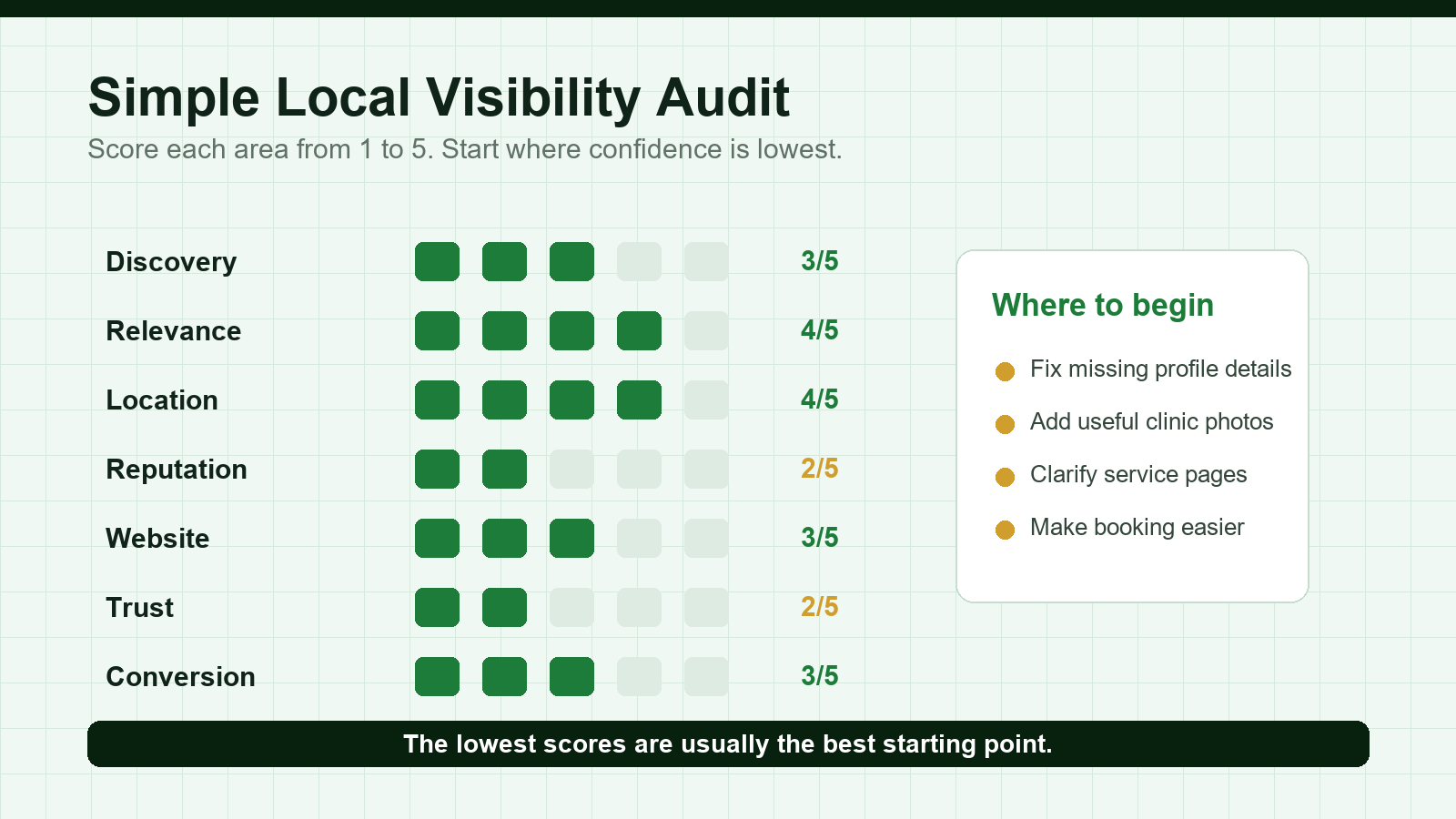
If you want to understand where your practice currently stands, score each area from 1 to 5: discovery, relevance, location, reputation, website, trust, and conversion. The lowest scores are usually the best starting point.
Final Thought
When nearby patients do not find your dental practice on Google, it is tempting to ask, "How do we rank higher?" That is a reasonable question, but it may not be the most useful one.
Start with: "Why is Google, and the patient, not seeing us as the right local option?"
The answer may involve relevance, distance, prominence, incomplete Business Profile information, a website that does not clearly communicate the practice, or a lack of trust signals. Local SEO is less about finding a shortcut and more about building a clear, credible digital presence.
For a dental practice, the objective should not be to appear everywhere. It should be to become easy to find, easy to understand, and easy to trust when the right nearby patient is looking for care.
Frequently Asked Questions
Why doesn't my dental practice appear when someone searches "dentist near me"?
Distance is only one part of Google's local ranking system. Google also considers relevance and prominence. A nearby practice may still have limited visibility if its online information does not provide a strong match for the search.
Does a Google Business Profile affect dental practice visibility?
Yes. Complete and accurate Business Profile information can help businesses appear in relevant local searches and helps patients understand the practice before contacting it.
Do Google reviews help local SEO?
Reviews and positive ratings can contribute to local prominence. Reviews also influence how prospective patients evaluate local businesses.
Does my dental website affect local search?
It can. Google uses publicly available information, and your website helps clarify services, location, trust signals, and appointment options.
How long does local SEO take?
There is no universal timeframe. Local visibility depends on the practice's current presence, competition, location, website, reputation, and other factors.
Recommended Internal Links
Sources & References
- Google Business Profile Help: Improve your local ranking on Google
- Google Business Profile Help
- Google Search Central: Creating helpful, reliable, people-first content
- Google Search Central: AI features and your website
- BrightLocal: Local Consumer Review Survey
- BrightLocal: What Makes Consumers Choose Your Business?